Do You Need a Lawyer for Irish Citizenship by Descent?
EU citizenship can sound reserved for the wealthy or well-connected. It is easy to assume the process must be complicated or require expensive professional help. For Irish citizenship by descent, this is often not the case. We offer a smarter way forward.
This Is Primarily an Administrative Process, Not a Legal Puzzle
Let’s be clear about one of the biggest misconceptions in this process:
This is not primarily a legal task. It is an administrative process with two areas of focus: documentation and genealogy. The Government of Ireland does not require applicants to hire a lawyer to submit an application.
There are many paid services that offer to handle the Foreign Birth Registration (FBR) process for you, including citizenship assistance companies, law firms, and other providers. These services can charge several thousand dollars for document retrieval and application preparation that many applicants can complete themselves with the right guidance.
Even if you hire paid help, you must still complete several key steps yourself. This includes obtaining compliant passport photos, providing a witnessed photocopy of your government-issued ID, gathering acceptable proof-of-address documents, and signing the printed application form in front of an appropriate witness, to name a few examples. Don’t expect a completely “hands-off” experience, even if you are paying thousands of dollars.
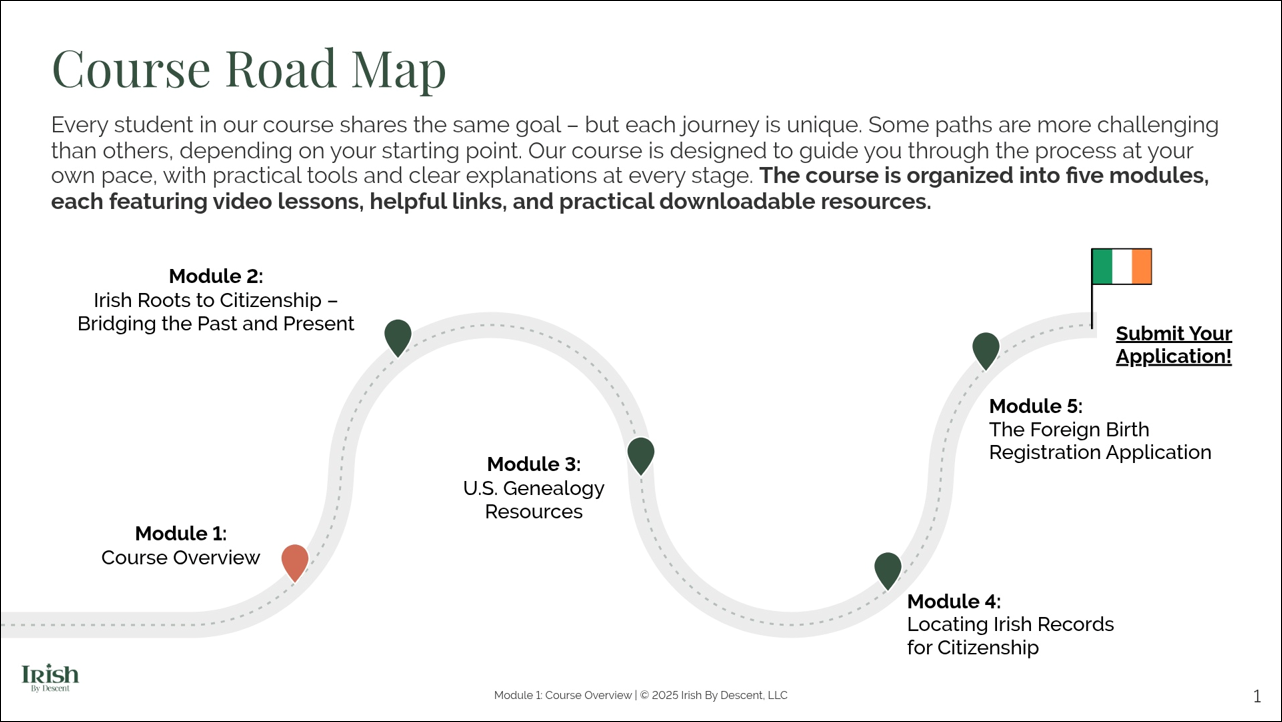
The final module of our self-paced online course shows exactly how to handle these tasks and flags common pitfalls. The course also provides downloadable templates to save you time and prevent confusion, all at a fraction of the fees typically charged for this type of work.
Additionally, if you want your paid support service to order certified copies of vital records on your behalf, some vital record offices may require a Power of Attorney. This is a whole separate decision and source of stress for many people. In contrast, our course explains in detail how to order certified copies of both U.S. and Irish vital records that are required for your application.
Paid support services typically have many clients and competing responsibilities. Once your file is on their desk, you are on their schedule, not yours. With our online course, you can move as quickly or as slowly as you want, on your own schedule. Also, some paid support services will expect you to come to them with key details about your Irish-born grandparent already researched and confirmed.
The course walks you through the entire process from start to finish, no matter how much or how little information you already have today.
You Don’t Need a Law Degree, You Need a Clear Roadmap
Unlike many similar EU programs, Ireland’s process is in English and avoids many administrative hurdles found elsewhere. Still, without a clear plan, it is easy to lose months in the preparation stage, trying to figure out which documents you need and how to meet the requirements.
Additionally, small mistakes with your submission can slow things down once your application is under review. Common examples include sending the wrong proof-of-address documents, submitting passport photos that are not properly witnessed, or ordering a short-form birth certificate instead of the required long-form version. If the application package is not accurate and complete, it may lead to avoidable delays while issues are addressed.
Application errors can cause frustrating delays in processing, but you do not need a law degree to be prepared. You need a clear roadmap to avoid mistakes and stay on track. Our self-paced online course is that roadmap.
We built this course with care because too many Irish Americans felt lost in the process, were unsure where to begin, or paid expensive support services for something they could have done themselves with the right support. You are the hero of this story. Our course serves as your navigator, giving you the plan and the tools to move forward with confidence.
Broadly speaking, very few people are given this opportunity. We encourage you not to overlook it. Even if you do not choose Irish By Descent and instead decide to hire paid support, we hope you will move forward while you are still eligible to apply. We believe waiting to act could lead to deep regret.
Guidance for Common Pitfalls and Uncommon Situations:
This is not rocket science, but there are pitfalls and common points of confusion for people who are not familiar with the process. The course is carefully designed to make each step clear and help you avoid many of the most common mistakes.
We also strive to include details and advice for more uncommon scenarios – such as how to approach getting certified translations for vital records in another language besides English or Irish. For example, this can matter if your Irish American mother was married in France and her marriage certificate is in French.
Additionally, if you encounter a very unusual situation with your family’s specific case and you need an official answer, we explain how to contact Ireland’s Department of Foreign Affairs by phone or webchat. Support staff are generally very helpful, responses are typically quick, and yes, they speak English!
Note Regarding Obtaining Vital Records:
Many applicants will already have several certified copies of vital records on hand before they begin. Once key family details are confirmed, obtaining the remaining certified vital records for a parent and Irish-born grandparent is usually a straightforward administrative step, whether that means ordering copies yourself or coordinating with family members when needed.
However, access to vital records and other supporting documents is governed by the rules of the issuing authority (which may be a U.S. state or local office, or a non-U.S. government agency), and some offices may require additional documentation, authorization, or state-specific steps in certain situations.
The Department of Foreign Affairs states that original documents, including original certificates, are returned at the end of the Foreign Birth Registration process.