Brutal treatment, unexpected kindness, and warnings to those who would follow. Historian Cian T. McMahon uncovers a little-known way Irish emigrants made their voices heard about life at sea during the Great Famine.
A New Perspective on Life at Sea during the Great Irish Famine
The human exodus from Ireland during the Great Famine peaked in 1851 when over 254,000 men, women, and children fled overseas. One of the ships that carried Irish emigrants that year was the Jeanie Johnston, a three-masted barque based out of Tralee, County Kerry.
If you have ever visited Ireland, that name, the Jeanie Johnston, might ring a bell. A replica of the original ship is now a living history museum at anchor at Custom House Quay in Dublin, a short stroll from EPIC: The Irish Emigration Museum. Between 1848 and 1855, the Jeanie Johnston carried 2,500 passengers westward on sixteen journeys across the Atlantic Ocean.
As a twenty-first-century historian, I have to admit that it is nice to be able to climb aboard and witness the living conditions of a Famine-era sailing ship. But I have always been much more interested in the thoughts and experiences of the emigrants themselves. Unfortunately, their words were rarely recorded.
One place I have managed to find their voices, however, is in resolutions published in local newspapers. After arriving at their destination, a given ship’s emigrants would sometimes present their vessel’s captain with a public commendation—or rebuke—of the crew’s behavior during the voyage. These resolutions offer rare glimpses into what Irish emigrants themselves thought of the sea voyage during the Great Famine.
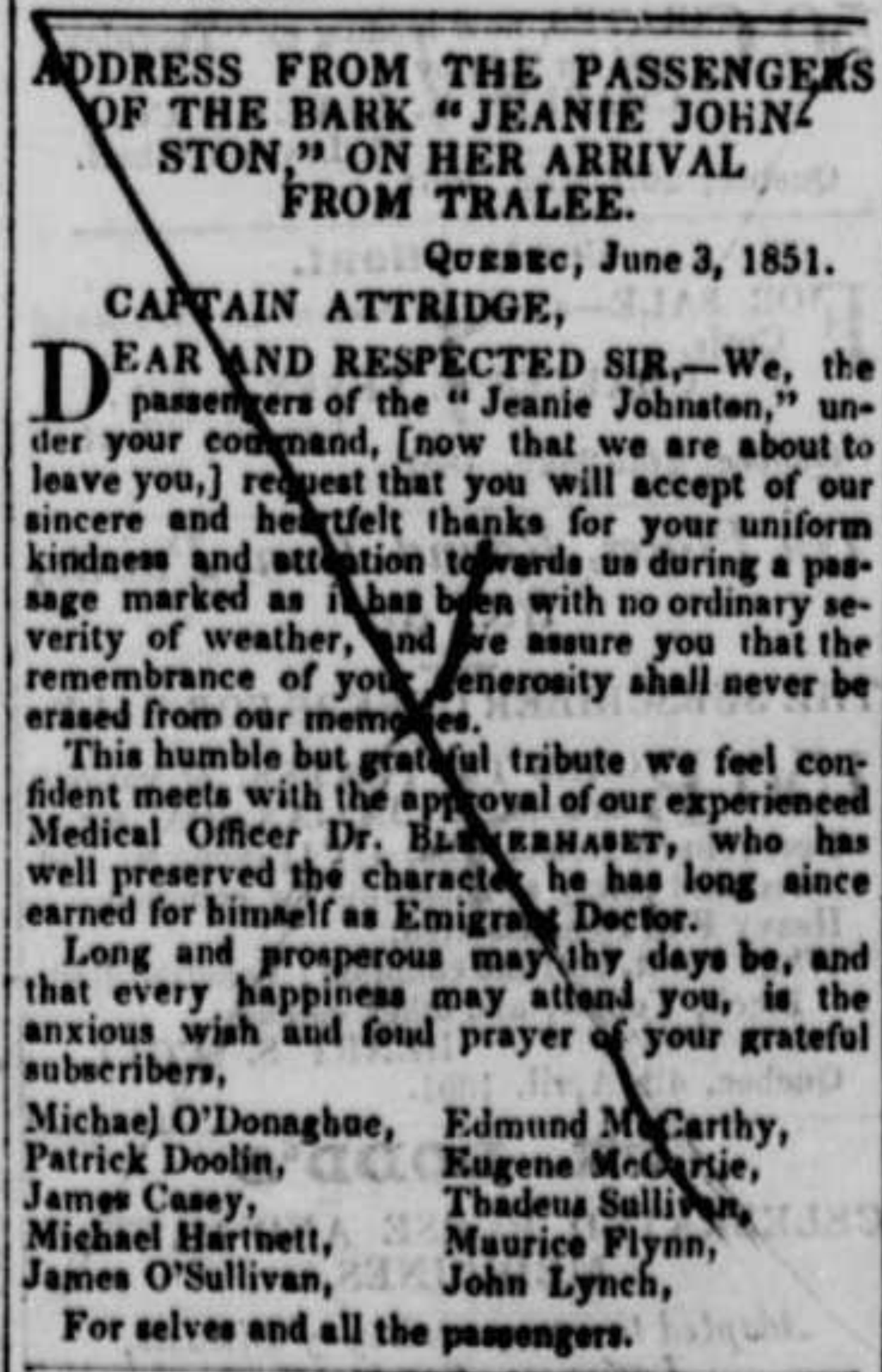
Resolution of thanks from Jeanie Johnston passengers. Morning Chronicle, Quebec, 1851. Bibliothèque et Archives nationales du Québec.
In June 1851, for example, a number of passengers aboard the Jeanie Johnston publicly addressed Captain James Attridge with a letter that was subsequently published in Quebec City’s Morning Chronicle. They offered their “sincere and heartfelt thanks for your uniform kindness and attention” throughout the journey and singled out the performance of the ship’s surgeon, Richard Blennerhassett, “who has well preserved the character he has long since earned for himself as Emigrant Doctor.”
These Great Famine-era passenger resolutions can be revealing. They were not always positive.
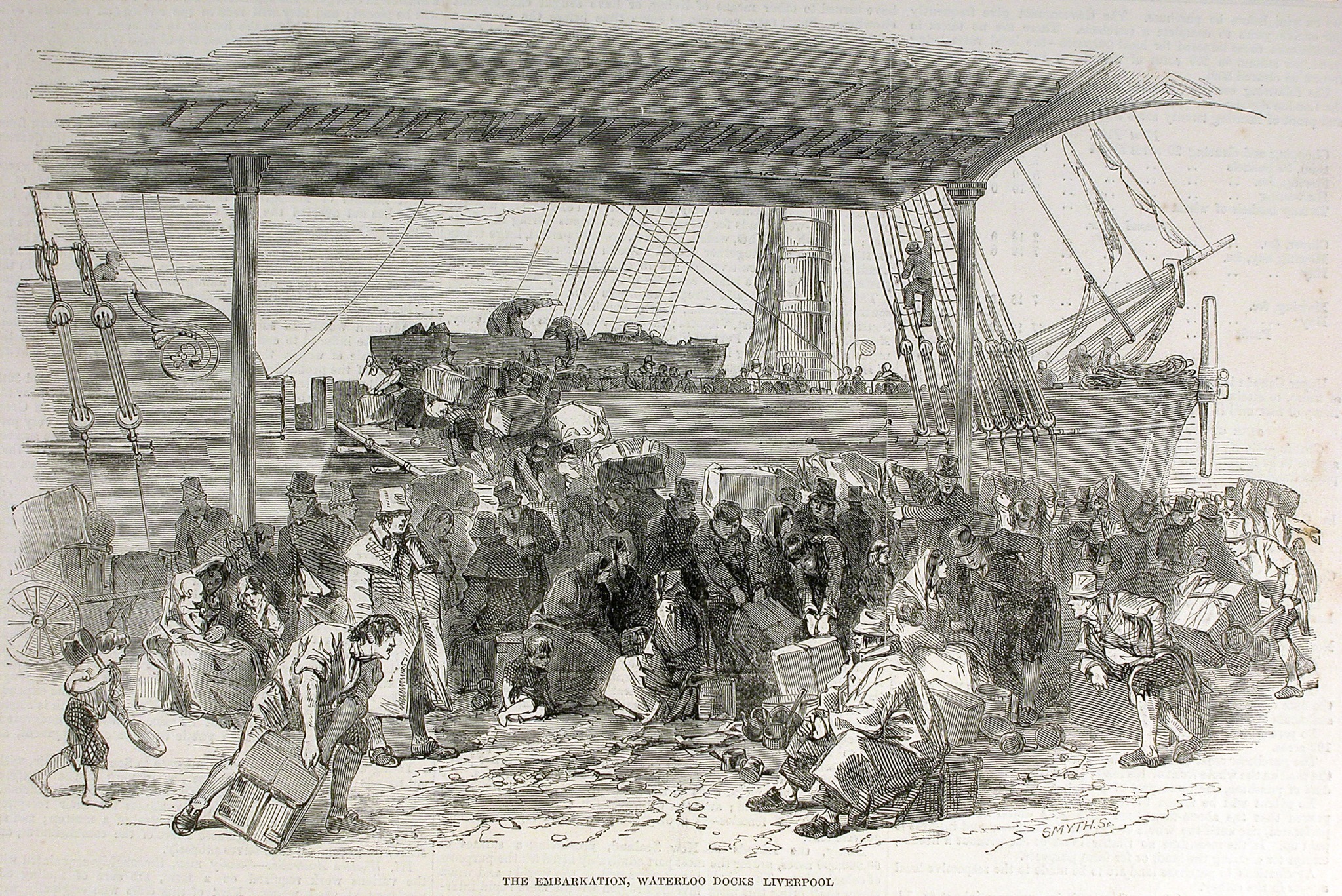
Emigrants boarding a ship at Waterloo Docks, Liverpool. Illustrated London News, 1850. McCord Stewart Museum.
“A Pirate and a Rascal”
Mass migration began soon after the Great Famine broke out in 1845. Over the next few years, it became clear that some ship captains were mistreating Irish emigrants but the passengers’ ability to protest was curtailed by their poverty, illiteracy, and fear of retribution by the powerful, monied classes who controlled the shipping networks.
In 1850, Irish landlord and philanthropist Vere Foster sailed to the United States aboard the Washington in order to gain “insight into the condition and prospects of Irish emigrants” at sea. Foster was horrified by the terrible treatment that he and his fellow passengers experienced at the hands of Captain Pitkin Page and his crew. At one point, when Foster complained, the First Mate “knocked me down flat upon the deck with a blow in the face,” he later recounted. The captain called him “a damned pirate [and] a damned rascal” and threatened to put Foster “in irons and on bread and water for the rest of the voyage.”
After arriving in New York, Foster drafted a resolution, which was signed by 120 fellow passengers, and published in the New-York Daily Tribune on December 27, 1850.
“We testify, as a warning to, and for the sake of future emigrants, that the passengers generally on board of this noble ship Washington […] have been treated in a brutal manner by its officers,” the resolution asserted, “and that we have not received one-half the quantity of provisions allowed by act of parliament.”
The second clause of that sentence, about the act of parliament, is interesting. During the late 1840s and early 1850s, the UK and American governments amended their Passenger Acts on multiple occasions to make sure emigrants were furnished with more food and better accommodations while at sea. Mentioning it in the resolution shows that passengers were willing to cite these laws in defense of their own comfort and safety.
But the first part, about the fact that their statement was meant to serve as “a warning to, and for the sake of future emigrants” is important too. It illustrates that passengers recognized their responsibility to advise other Irish about the importance of picking the right captain.
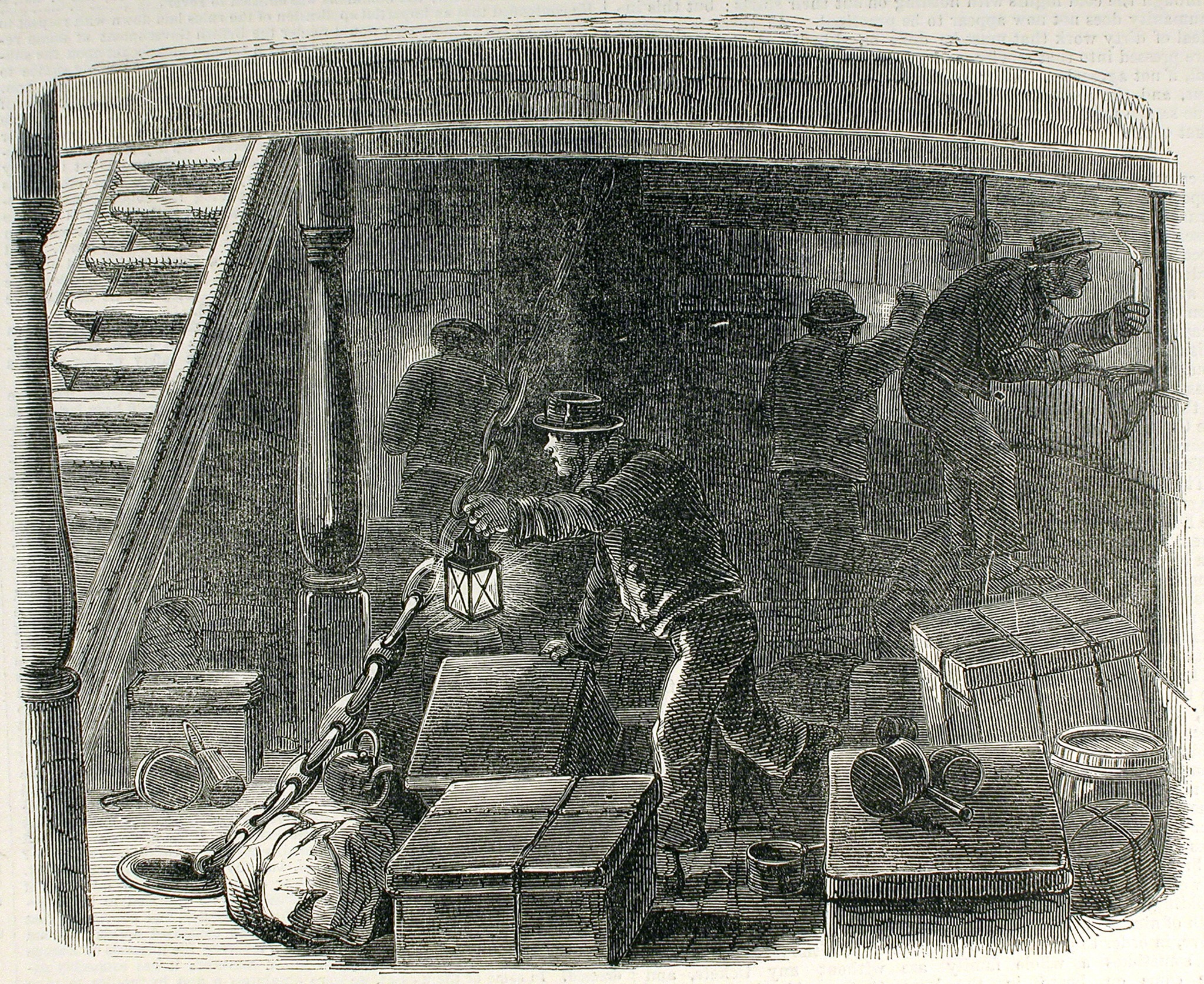
Searching for stowaways aboard an emigrant ship. Illustrated London News, 1850. McCord Stewart Museum.
“Kind Attention and Benevolent Consideration”
In August 1850, the Albion left Galway en route to New York, arriving in late September. Before disembarking, the passengers signed a resolution to Captain James Turner, expressing their “unqualified approval of your conduct as a navigator and our warmest gratitude for your kindness as a man.”
Offering a heady mix of political commentary and personal discomfort, the resolution thanked Captain Turner for all he had done for the emigrants. “Now that we are relieved from the bile engendered by the monotony and disappointments of the old world—disappointments which flow cruelly from alien misrule and injustice [which] mar all the natural advantages of our own green isle,” the statement explained, “we must acknowledge with gratitude that the kind attention and benevolent consideration evinced by you had the effect of completely neutralizing the horrors we experienced from that ‘acme of marine purgatory’, sea sickness, during the first week of the voyage.” From nationalism to nausea, Captain Turner was there to support his passengers.
In the context of mass migration, as hundreds of thousands of people were experiencing heartbreak and loneliness, Captain Turner was a beacon of kindliness and comfort.
“Rendered sensitive and melancholy on being separated, perhaps forever, from the land of our birth, and the fond friends of our youth,” the passengers continued, “it became your duty (evidently a pleasing one) to assuage our sorrows, and by your ready anecdote, your cheerful temper, and buoyant disposition, to distract our minds from grievous recollections of the past.”
This resolution, which was published in a newspaper back home in Galway, would have sent a clear message to those following in the wake of those who wrote it: emigration was a painful, dangerous experience. But there were those, like Captain Turner, who would help you along the way.
Cian T. McMahon, PhD is Professor of History at the University of Nevada, Las Vegas. His books include The Coffin Ship: Life and Death at Sea during the Great Irish Famine (2021) and When All the World was Irish: A Global History of Saint Patrick’s Day (2027).
Emigrants at the government inspector’s office in Liverpool before departure. Illustrated London News, 1850. McCord Stewart Museum.